
Table of Contents
- BLUF (Bottom Line Up Front)
- Executive Summary
- Key Findings
- 1. Geopolitical Context
- 2. Venezuela’s “Shadow Bitcoin Reserve”
- 3. Incidents
- 4. Cyber Operations Details
- 5. Threat Actors relevant for Venezuela
- 6. Technical Indicators
- 7. Order your own intelligence report
- 8. Sources
BLUF (Bottom Line Up Front):
In December 2025, a ransomware incident disrupted administrative systems at the state-owned oil company PDVSA, temporarily halting cargo operations. During the same period, multiple ransomware groups (including LockBit 5) targeted Venezuelan public and private sector entities.
In January 2026, the United States initiated Operation Absolute Resolve, a military operation reportedly integrating cyber capabilities to disrupt critical infrastructure in Caracas, including power distribution and air defense systems. The operation culminated in the detention of President Nicolás Maduro and his wife.
Executive Summary
Venezuela holds one of the world’s largest proven oil reserves. However, political instability, economic mismanagement, and sanctions have triggered a deep economic crisis. The country’s strategic partnerships with China, Russia, Iran, and Cuba provide economic and political support. Geopolitical tensions escalated in December 2025 when the U.S. seized a PDVSA tanker carrying ~1.85 million barrels of crude oil and tightened sanctions.
Key Events
- 15‑16 Dec 2025: Ransomware attack on PDVSA’s administrative networks forced suspension of cargo‑loading instructions and a reversion to manual records. PDVSA blamed the U.S., though internal sources indicated antivirus remediation caused the outage.
- 26 Dec 2025: LockBit5 ransomware group listed the Venezuelan logistics company tealca.com on its leak site.
- 3 Jan 2026: The U.S. launched “Operation Absolute Resolve", deploying over 150 aircrafts. President Trump hinted using cyber attacks to “turn off the lights” in Caracas, while U.S. Cyber Command tracked Maduro’s communications.
Threat Actor Landscape
Venezuela faces persistent ransomware campaigns from groups including LockBit 5, Lynx, Sinobi, Akira, alphv (BlackCat), and multiple others targeting financial, insurance, IT, and government entities. The info‑stealer Trojan Astaroth (Guildma) actively targets financial credentials in Venezuela and Latin America.
Additional Considerations
- Bitcoin Reserve: Unconfirmed reports suggest Venezuela may hold a “shadow” Bitcoin reserve of ~600,000 BTC (worth ~$60‑67 billion), representing about 3 % of Bitcoin’s circulating supply. U.S. control or freezing of these assets could affect global crypto liquidity.
Key Findings
- Geopolitical escalation: Tanker seizure (~1.85M barrels) and sanctions preceded U.S. military operation in Venezuela.
- Critical infrastructure targeting: Ransomware attack on PDVSA (Venezuelan state oil company) in December 2025 forced administrative shutdown and reversion to manual cargo operations.
- U.S. Operation in Venezuela: “Operation Absolute Resolve” a military operation in Venezuela that included coordinated airstrikes and a special-forces raid that resulted in the capture of President Nicolás Maduro and his wife. U.S. leaders suggested that cyber warfare contributed to disrupting Venezuelan defenses and communications, but technical confirmation of specific cyber operations have not been publicly disclosed or verified.
- Persistent ransomware campaigns: Multiple groups (Lynx, Sinobi, LockBit5, Akira) remain active against Venezuelan targets.
- Cryptocurrency reserves: Unconfirmed reports of ~600,000 Bitcoin “shadow reserve” (~3% of circulating supply).
1. Geopolitical Context
Venezuela is a country in northern South America with a long Caribbean coastline and some of the world’s largest proven oil reserves. For much of the 20th century, oil shaped Venezuela’s economy and made it one of the wealthier nations in Latin America, but political instability, economic mismanagement, and sanctions have led to a deep economic crisis in recent years.
Venezuela is strategically important to the United States primarily because of its vast oil resources. It possesses the largest proven oil reserves in the world, and much of its heavy crude is well matched to the technical capabilities of refineries on the U.S. Gulf Coast. Historically, Venezuela has been a key supplier of crude oil to the United States.
Alliance Structure: Venezuela’s principal strategic partners include China, Russia, Cuba, and Iran, each providing economic, military, or political support that helps sustain the Venezuelan government amid international pressure. President Trump has threatened to take action against Venezuela’s allies, particularly Iran. The U.S. control over Venezuelan oil threaten Russian and Chinese strategic and economic interests, potentially escalating tensions beyond the regional level and drawing in major global powers.
The cyber and military operations unfolded amid sharply rising tensions between the United States and Venezuela:
- Oil‑tanker seizure: In early December 2025, the U.S. seized a PDVSA tanker carrying ~1.85 million barrels of crude oil.
- Sanctions and rhetoric: The Trump administration had tightened sanctions and threatened a “total blockade” of Venezuelan oil shipments.
- Hybrid‑warfare precedent: The January military operation demonstrates how cyber warfare is integrated into military plans, blurring the lines between traditional and digital warfare.
2. Venezuela’s “Shadow Bitcoin Reserve”
After Maduro’s capture, reports have suggested that Venezuela may hold an alleged “shadow” Bitcoin reserve of around 600,000 BTC, potentially worth roughly $60 billion–$67 billion at current prices. If true, that amount would represent roughly 3 % of Bitcoin’s circulating supply. Speculation that the U.S. could freeze or take control of these assets has raised discussions about how a large, long-term lock-up could reduce available liquidity and influence the 2026 global crypto markets.
3. Incidents
| Date | Event | Source Verification |
|---|---|---|
| 15‑16 Dec 2025 | Ransomware attack on PDVSA administrative systems; cargo‑loading instructions suspended, staff revert to handwritten records. | The Record, and other outlets reported the attack, citing PDVSA sources who described it as a ransomware incident that triggered antivirus remediation, taking down the entire administrative network. |
| 26 Dec 2025 | LockBit5 ransomware group lists Venezuelan logistics company tealca.com on its leak site. Still affected as of January 5, 2026 | Baysec CTI documented the LockBit5 victim entry for tealca.com, a Venezuelan transportation and distribution provider. |
| 3 Jan 2026 | U.S. launches “Operation Absolute Resolve”: >150 aircraft, cyber operations, capture of President Nicolás Maduro. | Several outlets, note that U.S. cyber and intelligence capabilities were reportedly used to support the mission by suppressing Venezuelan defenses and contributing to power disruptions in Caracas. |
| 3‑4 Jan 2026 | President Trump suggests the U.S. used cyberattacks to “turn off the lights” in Caracas during the strikes. | Media quote Trump’s remarks and note U.S. Cyber Command’s involvement in the operation. |
4. Cyber Operations Details
PDVSA Ransomware Attack (December 2025)
- Impact: Administrative networks were taken offline, forcing a stop to cargo‑loading instructions and a return to manual record‑keeping. PDVSA publicly blamed the U.S., but internal sources stated that disruption stemmed from antivirus software trying to remediate a ransomware infection.
- Attribution (public claims): No ransomware group claimed responsibility; Venezuelan officials attributed the attack to “foreign interests.”
December 2025: Escalation of oil tensions
The United States seized the PDVSA-linked tanker Skipper, which was carrying an estimated ~1.8–1.9 million barrels of Venezuelan crude oil.
Washington expanded sanctions enforcement targeting vessels and companies involved in Venezuelan oil exports.
Export disruptions and tanker seizures worsened PDVSA’s storage constraints, forcing the company to curtail production and shut in some wells in the Orinoco Belt due to limited storage capacity.
U.S. Cyber Operations during “Absolute Resolve” (January 2026)
- Power disruption: President Trump stated that cyber capabilities were used to cut power in parts of Caracas.
- Air‑defense suppression: Breaking Defense and DefenseScoop reported that U.S. Space Command and Cyber Command provided “non‑kinetic effects” to suppress Venezuelan air defenses ahead of kinetic strikes.
- U.S. intelligence used cyber tools and network monitoring to track Maduro’s movements and communications leading up to the raid.
- Integrated planning: The operation exemplified the seamless blending of cyber, space, and kinetic effects in a large‑scale operation.
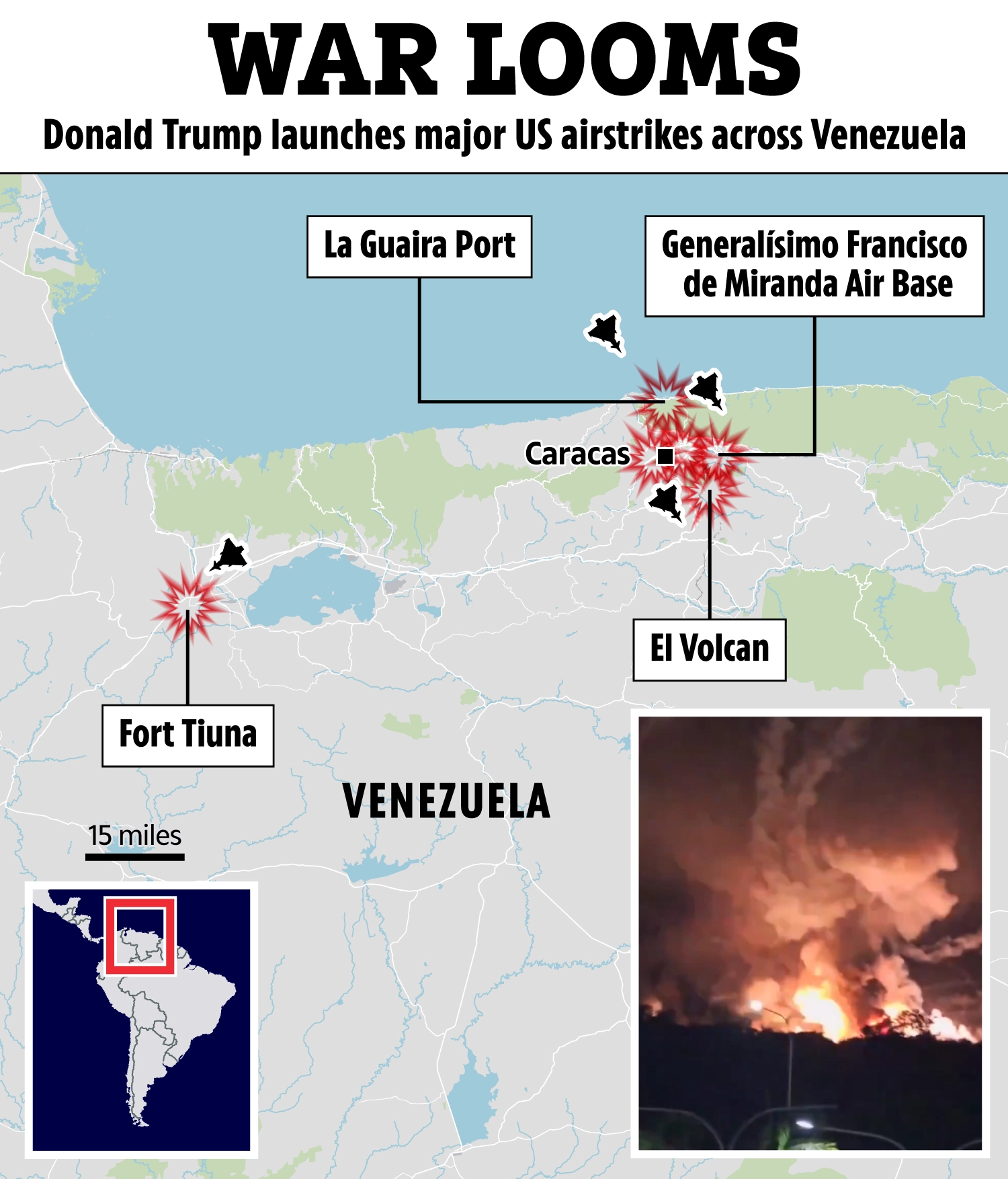
Source: The Sun - US airstrikes across Venezuela
5. Threat Actors relevant for Venezuela
| Actor | Relevance to Venezuela |
|---|---|
| LockBit5 | Ransomware group – lists Venezuelan victims (tealca.com) 24-12-2025 |
| Astaroth (Guildma) | Info‑stealer Trojan – targets financial/credential data in Venezuela & Latin America Ongoing (relationship confirmed) |
| Akira (GOLD SAHARA, PUNK SPIDER) | Ransomware group – double‑extortion attacks |
| alphv (BlackCat) | Ransomware attack on CA de Seguros La Occidental (Caracas insurance company) |
| dispossessor | Ransomware attack on amazing‑global.com (Venezuelan IT company) |
| the gentlemen | Ransomware attack on Venezuela Re (reinsurance company) |
| Saturned33 | Ransomware group – targets Venezuelan entities |
| Omoikane28 | Ransomware group – targets Venezuelan entities |
| kazu | Ransomware group – attacked “Venezuela’s Cooperative Registration and Management System” |
| izeeenn27 | Ransomware group – targets Venezuelan entities |
| Anonymous Venezuela | Hacktivist/Defacement group – targets the United States (not Venezuela) |
| Arabian Ghosts | Hacktivist/Defacement group – targets Venezuelan entities |
| Jateng Cyber Team | Hacktivist/Defacement group – targets Venezuelan entities |
| Empire | Hacktivist/Defacement group – targets Venezuelan entities |
| StarData | Ransomware group – targets Venezuelan entities |
6. Technical Indicators
- Astaroth C2: Uses GitHub repositories for configuration updates and targeting South American countries.
- PDVSA attack: PDVSA acknowledged a cyberattack that disrupted its centralized administrative systems and has been widely reported in media as resembling a ransomware incident, with antivirus remediation reportedly contributing to system outages. However, no specific technical indicators of compromise (IoCs) have been publicly released, and there is no publicly verified forensic attribution.
7. Order your own intelligence report
Have a specific topic in mind or want deeper insight into what’s happening in your organization’s cyber environment? We offer customized intelligence reports tailored to your needs. Contact us at kontakt@baysec.eu
8. Sources
- CNN - From Greenland to Iran: Trump’s threats stretch far and wide since his Venezuela strike (06 Januray 2026)
- Forbes - Maduro Captured: What It Means For Stablecoins, Oil And Bitcoin (05 Januray 2026)
- Politico – Trump suggests US used cyberattacks to turn off lights in Venezuela during strikes (4 Jan 2026)
- Breaking Defense – 150 aircraft, cyber effects and ‘overwhelming force:’ How the Venezuela operation unfolded (4 Jan 2026)
- DefenseScoop – US deploys 150‑plus military aircraft, drones and other tech in raid to capture Venezuela’s Maduro (3 Jan 2026)
- BleepingComputer – Cyberattack disrupts Venezuelan oil giant PDVSA’s operations (17 Dec 2025)
- Security Affairs – A cyber attack hit Petróleos de Venezuela (PDVSA) disrupting export operations (16 Dec 2025)
- The Record – Venezuela state oil company blames cyberattack on US after tanker seizure (16 Dec 2025)
- Reuters – Venezuela’s PDVSA suffers cyberattack, tankers make u‑turns amid tensions with US (15 Dec 2025)
- The Hacker News – Astaroth Banking Trojan Abuses GitHub to Remain Operational After Takedowns (13 Oct 2025)
- McAfee Blog – Astaroth: Banking Trojan Abusing GitHub for Resilience (11 Oct 2025)
- Reuters - US seizes sanctioned oil tanker off coast of Venezuela, Trump says (11 Dec 2025)